Sunday, August 12, 2007

mother teresa


A few thoughts from Mother Teresa:

It is a poverty to decide that a child must die so that you may live as you wish.

There should be less talk; a preaching point is not a meeting point. What do you do then? Take a broom and clean someone's house. That says enough.

There must be a reason why some people can afford to live well. They must have worked for it. I only feel angry when I see waste. When I see people throwing away things we could use.

The more you have, the more you are occupied, the less you give. But the less you have the more free you are. Poverty for us is a freedom.

There is only one God and He is God to all; therefore it is important that everyone is seen as equal before God. I’ve always said we should help a Hindu become a better Hindu, a Muslim become a better Muslim, a Catholic become a better Catholic. We believe our work should be our example to people.

Not so long ago a very wealthy Hindu lady came to see me. She sat down and told me, "I would like to share in your work." In India, more and more people like her are offering to help. I said, "That is fine." The poor woman had a weakness that she confessed to me. "I love elegant saris," she said. Indeed, she had on a very expensive sari that probably cost around eight hundred rupees. Mine cost only eight rupees. Hers cost one hundred times more.Then I asked the Virgin Mary to help me give an adequate answer to her question of how she could share in our work. It occurred to me to say to her, "I would start with the saris. The next time you go to buy one, instead of paying eight hundred rupees, buy one that costs five hundred. Then with the extra three hundred rupees, buy saris for the poor." The good woman now wears 100-rupee saris, and that is because I have asked her not to buy cheaper ones. She has confessed to me that this has changed her life. She now knows what it means to share. That woman assures me that she has received more than what she has given.

I guess I need to go pick up a broom...
- David


Friday, August 10, 2007

Featured Family Friday


Five years ago Dr. J. Matthew Sleeth and his family lived in a big house, had two luxury cars, loads of money, and lots of stuff. As chief of the medical staff at a large hospital, Sleeth was living the American dream—until he realized that something was terribly wrong. As he saw patient after patient suffering from cancer, asthma, and other chronic diseases, he began to understand that the Earth and its inhabitants were in trouble. Feeling helpless, he turned to his faith for guidance. He discovered how the timeless lessons of personal responsibility, simplicity, and stewardship taught in the Bible could be applied to modern life.

Excerpt from Serve God, Save the Planet by Sleeth:
"Over the past five years, my family and I have made significant lifestyle changes. We no longer live in our big house; instead, we have one the exact size of our old garage. We use less than one-third of the fossil fuels and one-quarter of the electricity we once used. We've gone from leaving two barrels of trash by the curb each week to leaving one bag every few weeks. We no longer own a clothes dryer, garbage disposal, dishwasher, or lawn mower. Our "yard" is planted with native wildflowers and a large vegetable garden. Half of our possessions have found new homes. We are a poster family for the downwardly mobile.
Because of these changes, we have more time for God. Spiritual concerns have filled the void left by material ones. Owning fewer things has resulted in things no longer owning us. We have put God to the test, and we have found his Word to be true. He has poured blessings and oppurtunities upon us. When we stopped living a life dedicated to consumerism, our cup began to run over. We have seen miracles."
I am currently reading Serve God, Save the Planet and have found it to be very convicting. Others who are recommending this book include: Brian McLaren and Shane Claiborne.
-Sarah

Thursday, August 9, 2007

RICH

Wednesday, August 8, 2007

Paper or Plastic?


It seems that neither are without fault. Paper bag production is expensive, requires more energy to recycle & they take up more landfill space. Many plastic bags are not biodegradable, and require more oil used for production. Not to mention all the plastic bags littered across the country. So more people across the country are bringing their own.

In March, San Francisco became the first city in the country to ban non-biodegradable plastic bags in large grocery and drug stores. Similar bag-banning measures are being considered elsewhere across the country.

Locally, there are a handful of grocers who give money back when you bring your own bags. Kroger is the latest to offer savings, with $.04 off your bill for each bag you bring.

I’ve been bringing my own bags now for almost a year. After unloading my foods, I immediately put the bags by the door or right back to the car. That way, they are always in the car when I make an impromptu stop by the store. It is so easy to do & you will not believe how sturdy these bags are. You can put much more in these bags than either plastic or paper.

Where to find them? Tote bags overflow at your local thrift store. Or you can find a great selection at reusablebags.com. >carrie.

Monday, August 6, 2007

Peace Counts

Peace Counts aims to discover role models for peacemaking around the world and to bring them broad exposure by creating fascinating features and photo essays. Peace Counts is looking to provide answers to the question: How does an individual actually “make peace”?

Peace Counts publications focus on role models for peace throughout the world. Peace Counts depicts people, groups, and institutions that have supported peace processes with especial creativity, credibility, long-term commitment, and success.

The following is an excerpt from ... and on Earth Peace to Men of Good Will:

Peace has come to the once unruly streets of New Haven, Connecticut. Today children play where the bullets of gang shoot-outs once flew. Geraniums bloom in the window boxes of former crack houses. Many gang members are either behind bars or have become upright citizens who sweep their sidewalks on Saturday mornings. Since the 1990s, crime rates in New Haven have fallen by more than 60 percent. The success can be credited to an unusual style of police work – “community policing.” “Community policing” sounds harmless enough, but it was a cultural revolution. It began in New Haven’s police academy, a former precinct house on Sherman Parkway.


Along with law, criminology, and firearms practice, the future cops learn standard English, read poetry, and rehearse nonviolent conflict resolution with role-playing games. They write plays about racial prejudice and produce them with inner city kids. The calligraphy of the greeting-card rhetoric outside is set forth in the classroom. “It’s never too soon to be friendly – you never know when it might be too late.”

The “recruits” became “students” and were drawn from every conceivable walk of life: homosexuals, single mothers, Latinos, African-Americans. In the school day, the firing range ceded time to soup kitchen visits. Kay Codish brought prostitutes, hustlers, abused women, the mentally ill, and the homeless into the classroom. She drilled her students nonstop in the Golden Rule: “Do unto others as you would have them do unto you. A police officer needs to remember that, almost more than anyone else.”

Source: http://www.peace-counts.org/eng/practice_146_start.html
Check out this website for more peace stories around the world!

How can we as individuals make peace in our community?
-Sarah

Friday, August 3, 2007

Featured Family Friday

My most important mentors were my parents. My father was a very prominent physician and cardiologist. Once a week he would see patients for free of charge for charity. And patients would come from all over the country, actually, to see him, on trains and buses. My mother would cook food for them and pay their bus fare and train fare. And my little brother and I would escort the patients in to see my father, who would not only write the prescriptions, but pay for the medicines for them as well. And at the end of the day, my parents would sit with me and explain what had happened during the day. And the moral of the lessons always was that if you want to be happy, then you make somebody else happy.

I grew up with this notion that you must always have somebody in your life that you can trust, that you can confide in, that you can seek advice from, and that you can learn skills from. And the best skills come not in school, they come from people that you're closed to, that care about you, that you care about.

At one point in time, I have three, or four, or five people that I am acting as a mentor for. And I listen to them mostly. I listen to what's going on in their life, what's going on with their friendships, in their relationships. To be a mentor you need to understand what's going on in a young person's life. ---Deepak Chopra
What are ways that your family serves the community? What are ways that you can make someone else happy? -Sarah

Wednesday, August 1, 2007

What are we protecting?


A quick comparison of annual spending (source: ODE magazine, October 2006)

$900 billion U.S.
Annual worldwide weapons spending


$150 billion U.S.
Yearly budget for all eight Millennium Development Goals*

  1. Eradicate extreme hunger and poverty
  2. Provide universal primary education
  3. Promote gender equality
  4. Reduce child mortality
  5. Improve pre-natal health
  6. Combat HIV/AIDS, malaria and other diseases
  7. Ensure environmental sustainability
  8. Develop a global partnership for development

*The Millennium Development Goals were developed by the United Nations to improve the quality of life of citizens worldwide, with a target completion date of 2015. All 191 member states agreed to participate, but have been sharply criticized for their lack of effort.

When I look at these figures, it is startling and disheartening. I ask myself why does the world spend this much on weapons? What are we trying to protect, especially here in the U.S.? Are we fearful that one day a billion starving people might find their way to our land and we will have to protect ourselves from them stealing our food? Sorry if I am too rash in my comments but I look at a picture of starving children and wonder are we truly doing all we can to "improve the quality of life of citizens worldwide?"

-Sarah


Monday, July 30, 2007

Confession

Well, the money sermon series at Otter Creek is over. And I thought that overall it was very good. Like with everything else, I could pick holes in some things, or wish that Tim had pushed a little harder in other places, but for what it was, I felt like it was a good series for the church to hear.

What I truly appreciated was our friend's confession and request for prayer yesterday. As much as anything Tim said, I think that hearing from someone trying to live a lifestyle counter to the consumeristic greed of American society was one of the most powerful things that people could have heard. I hope that it gives hope to other that might not be within this group that there are those seeking a different way to live.

So, thank you, J. For your courage and your example. And I would ask the same prayers for our family that she asked for hers.

Friday, July 27, 2007

Featured Family Friday

There is currently a break in family's who have signed up to post on the Featured Family Fridays. So, I thought I would take this oppurtunity to recruit...YOU! If you can share from any of the following questions/topics below, please comment to this post and I will sign you up for a future Friday. Or, you can email me at sarahdenniswilson@yahoo.com.

  • How does your family display Jesus' teachings of nonviolence?
  • How does your family respond to a homeless person or needy family?
  • How does your family strive for simplicity?
  • In what ways does your family live out community?
  • Does your family have easy ways to protect the environment?
  • What are creative, God-pleasing ways that you use your money?
  • In what ways does your family counter "envy" that arises from "keeping up with the neighbors?"

These are just a few ideas and maybe you have ideas of your own that you would like to share. Maybe, you even have answers to some of the questions that the Stanleys (last Friday's post) shared. Also, I keep using the word "family" but do not want to imply that this feature has to be from a married couple with 2.5 kids. We would love to hear from single, married without kids, single with kids, empty-nesters, and any other status I have not mentioned. Maybe you grew up in a family that displayed some of these things and could share how your parents lived this out. Whatever the situation, whatever the response, even if you read this blog regularly but never comment and we don't know you, this blog would love to hear from YOU!

-Sarah


Tuesday, July 24, 2007

Nurture the Earth by Composting


About one third of the space in landfills is taken up with waste from our yards and kitchens, just the type of material that can be used in compost. With a small investment in time, you can contribute to the solution to a community problem, while at the same time enriching the soil and improving the health of the plants on your property.

Metro Nashville's Omohundro Center now offers compost bins from Earth Machines.
Retailing at $85, they are offering them for $40. Now is as good a time as any to learn how to compost. For more info about composting, read here or here.

The Omohundro Center also takes residential trash, furniture, furniture, mattresses, tires, etc. plus all the regular recyclables. Happy Composting! >carrie.

Monday, July 23, 2007

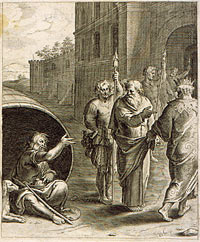
Diogenes the Dog

The notion of living simply is nothing new. It's been around for centuries. Some of the earliest practitioners of simplicity were the cynics, a school of ancient Greek philosophers. They rejected the social values of their time, often flouting conventions in shocking ways to prove their point. They claimed that wealth, popularity and power tend to dethrone the authority of reason and pervert the soul from the natural to the artificial. While some of their practices may have been crude, they saw rejecting the dross of materialism as a virtue.

One of the prominent cynics was Diogenes, who lived during the 4th centure B.C.E. He was a vulgar and sordid man who disavowed worldy possessions and chose to live in poverty. He slept in a tub and destroyed the single wooden bowl he possessed upon seeing a peasant boy drink from the hollow of his hands. Marveling at the boy, Diogenes remarked, "A child has beaten me in plainness of living."

When asked what was the proper time for supper, Diogenes replied, "If you are a rich man, whenever you please; and if you are a poor man, whenever you can."
Diogenes also said "He has the most who is most content with the least."

The story goes that while Diogenes was relaxing in the sunlinght on the side of the road one morning, Alexander the Great came upon him. Thrilled to meet the famous philosopher, Alexander told Diogenes that he would grant one request and give Diogenes anything he wanted from his kingdom. Diogenes motioned with his hand and replied, "Could you please move? You're blocking the sun."

Diogenes asked Alexander what his plans were. Alexander answered that he planned to conquer and subjugate Greece. "Then what?" Diogenes asked. Alexander said that he planned to conquer and subjugate Asia Minor. And then? Alexander said that he planned to conquer and subjugate the world. What next? Alexander the Great told Diogenes that after all that conquering and subjugating, he planned to relax and enjoy himself. Diogenes responded: "Why not save yourself a lot of trouble by relaxing and enjoying yourself now?"

Diogenes was particularly upset by extravagant and lavish interior decorations, and at one rich man's house, on finding himself surrounded by expensive carpets and sumptuous cushions, Diogenes spat in the owner's face, and then wiped it with his rough cloak and apologized, saying it was the only dirty place in the room he could find to spit.

There are numerous examples of simple living throughout history from which we can learn. Can you think of any others?
- David

Friday, July 20, 2007

Featured Family Friday

Presenting the Stanley Family -- There are five of us living in the suburban utopia of Spring Hill, TN. Daren and I just celebrated our tenth anniversary of wedded bliss. Our lives have been richly blessed with our three daughters – Mary Carsen (4), Eliza (2), and Nora Blayre (8 weeks). With our recent third addition to the family, our sanity hangs by a thread from moment to moment.

I was reluctant to write anything for the blog. Daren and I feel very inadequate to contribute in any form. Simplicity is far from the essence of our lives. We stand in awe of most of the people in this group who meet together regularly, and our mouths water for change in our own lives. Please do not continue to read this if you want practical advice in how to live simply. We have little to offer as of yet in our journey. We offer ourselves and our struggle along this process.

Fluctuating – That describes our family history – including our finances, our personal theologies, and our marriage relationship among other things. We have long desired to be fully committed to outreach and to live life beyond the status quo. However, we have continually flip-flopped between pursing a higher calling and running to the familiarity of the typical American dream. Our first five years together were spent seriously seeking out full-time mission work. When that fell through, we moved to a trendy neighborhood, bought a restored 1920s bungalow and furnished it racking up $40,000 in credit card debt. It has taken us two downsizes in houses to recover from this, to live within our means and to keep me home to mother our children.

We are evolving as a family, and I have high expectations to see where God leads us. I truly believe that we will see God work in our family if we are still enough to discern his voice. Currently, we are struggling the following:
  • As a family, how can we position ourselves most effectively to reach out to others? Do we relocate to inner city Nashville in order to do this? Are we compromising the safety of our children in so doing?
  • How do we experience community in the deepest sense? How do we best develop enriching relationships for true accountability? Does this mean some type of communal living situation?
  • How can we shape our children to lessen the effects of consumerism, competition, performance-based self-worth and vanity in their lives? Is home schooling part of the answer for this? We are actually about to begin our first year of home schooling.
  • How can we practically go green as a family? How do we weigh the immediacy of our money concerns with the long-term effects of our daily decisions on the environment? For example, sticking to our budget vs. buying environmentally friendly diapers.
  • How important are our money concerns when there are others wasting away from lack of resources? Is it moral for us to save money at all when others lack clean water and a sustainable diet of any kind?
  • How can we best be socially conscientious consumers? ? Do we spend more money just to buy fair trade clothing and coffee? Do we change our bank and our mortgage company because I just found out that both have histories of unfair business practices (Discovering this was due to Sarah’s referring us to http://www.coopamerica.org/programs/rs/. Thanks, Sarah, I guess.)
  • On a very personal level, what about my identity as a fairly fashionable mom who outfits her children with bows the size of Texas? Very shallow, I know!!! Being concerned about the environment, contemplating communal living and living simply all conjure up hippie images for me. I can dig this new hippie image, but I feel the need to spend several hundred dollars on different clothing from Pangaea, Patagonia and Anthropologie.

Any insights and constructive feedback are more than welcomed. We definitely appreciate the encouragement and positive peer pressure from the group to seek out purity and holiness in our lives.

God, have mercy on us and move us beyond discussion to practice. -- Christy

Wednesday, July 18, 2007

The Best Things in Life are Free

As a stay-at-home mom of a 4-month old, some days I begin feeling "trapped" inside the house. So this past Saturday, my husband told me that he would stay home and I could go anywhere I wanted. As he began to suggest ideas, we realized that most of the things cost money. "Go to....Starbuck's, Target, Borders, Blockbuster." Now, I'm not saying that any of these places are bad, but it is interesting that as a culture we are so driven by spending money to make us happier or to entertain us. There have been countless times that I have bought a new outfit because I was feeling down, wanted to reward myself, or for some special holiday/event. There are other times where I want to get together with friends and we suggest going out to eat, going to the movies, or meeting for coffee. I enjoy doing all of these things so it is hard for me to suggest something different.

What if instead of:
Going shopping, we shared/exchanged clothes.
Buying a book or renting movies, we borrowed from a friend or went to the library.
Going out to eat, we shared meals in our homes (plus you can visit longer with friends and don't feel rushed out of a restaurant).
Going to the movies, we went to a park.

Here are some events around town that are free in the summer:
at Centennial Park: Shakespeare In The Park, Movies in the Park (although ended in June :( )
take kids to Sprayparks: Watkins Sprayground, Kirkpatrick Spray ground, or at the Bicentennial Mall (near Farmer's Market)
at the Frist Center: Last Friday of the Month (May-October) are free concerts and free admission to the Frist

Does anyone else have any ideas for free things to do?
-Sarah

Monday, July 16, 2007

Jesus is Lord

I've spent the last week or so thinking about how Paul uses Lordship in his thinking (in preparation for teaching Tim's class on Paul yesterday; you can see what I did over on my blog). The idea of lordship is one that most of us have probably heard and that taking Jesus as Lord, means the other aspects that we often wish to succumb to have to be subordinated. But it also had a political motif, in that Caesar was often named as Lord and naming Jesus as Lord is a direct confrontation to that.

A particular quote from an N.T. Wright lecture at the Christian Aid conference.

http://www.ntwrightpage.com/ActJustly_Putting_World_Rights.mp3

"The Gospel is NOT 'You're a sinner, but Jesus has died so you can go to Heaven.' That is one of the results of the Gospel. The Gospel is, in the New Testament, 'Jesus is Lord.' or slightly more expanded, the crucified and risen Jesus is Lord. And when you name Jesus as Lord, and you take your life in your hands when you do so, you're implicitly telling all sorts of powers that are very powerful, that they are at best secondary, and at worst blasphemous idols. And they're not gonna like that, and they're going to fight back."

This is something that I have to keep in constant mind as Sheryl and I tried to make incremental steps toward more simplicity. That if we say that the consumeristic mindset is not the lord of our lives, there will be a struggle in that, and that's why the group is so appreciated, even just the idea that there are others out there struggling with the same issues and are at different places in this.

Friday, July 13, 2007

Featured Family Friday

The Sanders Family

Doug and I have two children. Lauren, 23, who just married, is an emergency room nurse. Houston is 18 and headed to the University of Tennessee in August. We have lived half of our married life (30 years, yikes!!) in Nashville and the other half of our married life in small town USA. Life in a small town was definitely simpler and less stressful for our family. We have just spent the last few years following Houston around the country as he played ice hockey. We believe in helping our children find their passion and pursue it. We also believe that active and involved teenagers will get into less trouble than those with a lot of time on their hands--"a tired teenager is a good teenager".

We have been recyclers for a long time. Due to financial necessity, we furnished our household with things we could find at rural auctions and very rural antique/junk stores. It became our pastime and entertainment to comb the countryside looking for pieces to furnish our home. There is something satisfying about cleaning, sanding, and oiling an old piece of wood. The ultimate recycling is taking something used for 100 years and finding a use for it in your home. Each piece in our home has a story, including the day we found it and brought it to our house.

On future housing, Doug and I do not currently agree on the next step. He wants to move downtown inside the loop, or at least near it, and live near those in need. I, on the other hand, would like to move away to a more rural area and build a "green" house with solar energy, geo-thermal, wind energy, gray water reclamation, etc. Under current city codes, not much of that can be done inside the city. So, we are currently looking at options and we will hopefully find a solution that will make both of us happy.

Our life has taken a bit of a change in the last two years going from an "executive" family with one set of expectations to a ministerial family with a whole different set of expectations from the world. I think the world as a whole has always expected ministers to lead a simple life, whether they themselves lived that role or not. We continue to look for ways to keep it simple and help others to look for a more simple, peaceful way of life. What a great gift it would be if we could give simplicity and peace as well as food and housing to those in need of "benevolence". That could be the ultimate form of giving, both for body and spirit.

Wednesday, July 11, 2007

Building Community Through Hospitality


. . . I have never met anyone who was offended because I opened my door and invited her to come in. Karen Mains

Hospitality was an integral part of the faith & community of Francis & Edith Schaeffer. They founded L’Abri in Switzerland in 1955 when they decided to open their home to be a place where people might find satisfying answers to their questions and practical demonstration of Christian care. It was called L'Abri, French for "shelter," because they sought to provide a shelter from the pressures of a relentlessly secular 20th century.

Buddy & Bernie Arnold, also known for tremendous hospitality, shared their most primary thoughts on the subject years ago. Here they are:
-“Be Yourself. “
-“It’s Going to be a Lot of Work.” (Schaeffer also expands on this, with comments about the time, energy & loving devotion that hospitality truly requires.)
- “You never know how much good you do from just a cup of coffee.” Sometimes we just need a little kindness and a listening ear.

The busyness of life often prevents us from being hospitable to those around us and those in need. Today, why don’t you get out your calendar and be intentional with inviting others to experience your hospitality, conversation, and encouragement?

Learn more about L'Abri from Edith Schaeffer’s books, “L’Abri”, “The Hidden Art of Homemaking” & “Tapestry”. >carrie.

Monday, July 9, 2007

Selling Your Possessions

Two times today I attempted to post some thoughts on the rich young ruler (Luke 18) and both times I erased it somehow.
Maybe I'll try to recreate it some other day.
Sorry.

Feel free to post your own thoughts on the subject.
- David

Friday, July 6, 2007

Featured Family Friday

We are the Conleys. I am Amanda, my husband's name is Seth, and we have three boys: Kaleb (10), Elijah (6), and Emet (16 mos.) I had to think long and hard about how we as a family live a simple life. My mind went in several directions at once, until I boiled it all down to this; God doesn't ask us to do more than we can, in fact it is by what He has done that means anything at all; but what he does ask us to do is to believe what He says. (Romans chapter 4). This is as simple as it gets. I try to teach my children that believing is not just knowing, but actually acting on what you know. Such as: if you said you believed that the chair your host offered you was going to be sturdy enough to hold you, but you refused to sit in it, then you would not be truly believing (and you would hurt your host's feelings). So, in believing the Lord, we must know His Words and act on them.

-Our family lives simply by keeping our eyes on Jesus. We know that if we do this first, then everything else will fall into place according to His will. "Let us fix our eyes on Jesus, the author and perfecter of our faith, who for the joy set before Him endured the cross, scorning it's shame, and sat down at the right hand of God." Hebrews 12:2
-We encourage each other and teach our children to stay in the Word of God. "Jesus answered, 'It is written:'Man does not live on bread alone but on every word that comes from the mouth of God."" Matthew 4:4
-We try to live with open hands by giving generously and trusting God to provide for us. (2 Corinthians 9:6-15, Matthew 6:25-34) We recently had our boys go through their room and give away toys to ThriftSmart which benefits New Hope Academy, Mercy Children's Clinic, African Leadership and the Belize Project. We make sure to talk to our kids about why we are giving.
-Prayer is another way that we live simply for the Lord. Sometimes there is nothing to do but pray. God promises to honor our prayers, and we teach our children that praying is like agreeing to open up our hearts before the Lord. We know that He always knows our hearts and everything that is going on in our life before we bring it to Him in prayer but prayer is important because:
*It is an act of belief. (Hebrews 11:6)
*It opens our eyes to the needs of others. (Ephesians 6:18 & James 5:13-16)
*It allows us to confess our sins. (1 John 1:9)
*It allows us to praise(Hebrews 13:15) thank (Philippians 4:6) God. And to know that He hears us!(1 John 5:14)
In my personal prayer life I not only pray for friends and family, but for our church, our country and the persecuted church. We don't live a perfect Christian life, nor is everything simple, but I am thankful that God has left us His Word that we might know Him and simply believe.

Tuesday, July 3, 2007

Shop with a Social Conscience


Whether you are buying things you "want" or "need," you can at least be socially responsible in your shopping. But what does it mean to be socially responsible when shopping? The Better World Handbook states "different companies manufacturing the same product can have radically different impacts on the environment, workers, businesses, and communities." Every time you make a purchase, you are essentially making a vote that says you support the actions that a particular company makes to produce it's product.
The difficult question comes into play when you are simply trying to buy a white t-shirt. For example, do you buy a white t-shirt from Wal-Mart that will be cheap (and you could use the money you saved to give to a person in need) where your money goes to one of the most socially irresponsible companies or do you buy a white t-shirt from Patagonia that will cost you considerably more yet your money goes to one of the highest rated socially responsible companies?
Though there may not be a right answer, I do think that we should at least take a look at some of the lower rated companies in question and see why they are rated so poorly. You can check out your favorite store at the responsible shopper: http://www.coopamerica.org/programs/rs/ and see how they check out. You also can purchase pocket books to carry with you during your shopping to see how products/companies check out: Shopping for a Better World and The Better World Shopping Guide. It may or may not impact you to continue shopping where you do.
-Sarah

Monday, July 2, 2007

Money

Yesterday, at Otter Creek, Tim Woodroof preached a very, very good sermon as a kick off to his series on Money. It's available at http://ottercreek.podomatic.com/entry/2007-07-01T15_17_32-07_00 and well worth the listen.

Why do you all think it is so hard to talk about money issues in the church? Is it because whenever money is talked about it's usually associated with giving? Tim even went to great pains to say that he wasn't going to be talking about giving in this series. Has money become such a private thing that even those people who are supposed to be united under Christ don't have the ability to honestly share what they do with money? Are we afraid that if we share, we'll be embarrassed at what we spend our money on? Does it take a series like this to get people talking?

And as another followup, if you listened to the sermon or were there, what else would you like to hear about money from the pulpit? What do you need to hear?

I know, I know, lots of questions, but I'm just a curious guy, I guess.

Phil